Real-time VFX Portfolio
Alan Lee
Junior Real-Time VFX ArtistStylized ARPG combat effects in Unity and Unreal Engine 5, built to read clearly and scale with gameplay. Strongest in shaders and procedural materials. Unity (VFX Graph, Shader Graph, Shuriken) · Unreal Engine 5 (Niagara, Materials, Blueprints)
· Shaders · Procedural Materials · C# · Git
Real-Time VFX

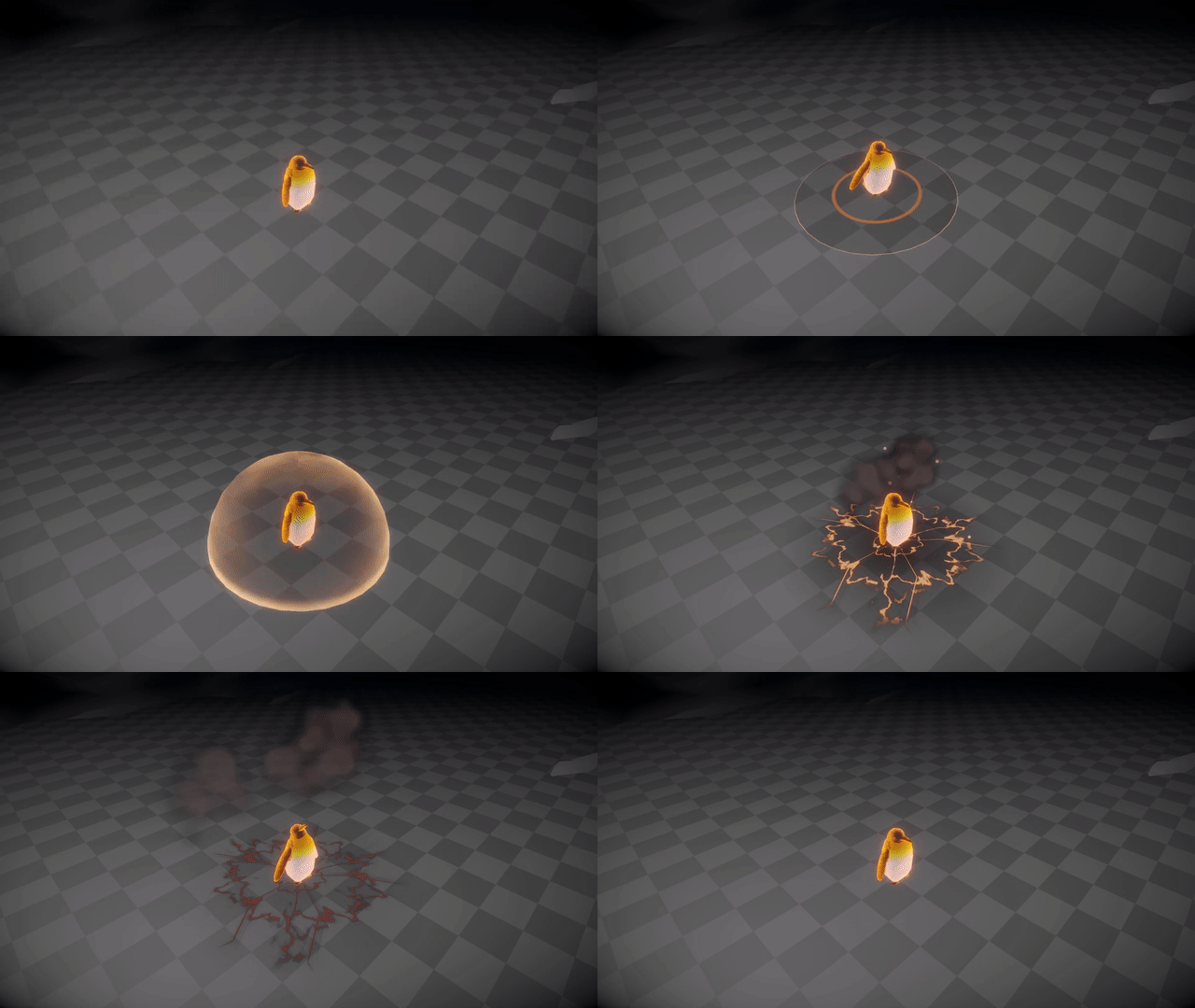
Fire Explosion
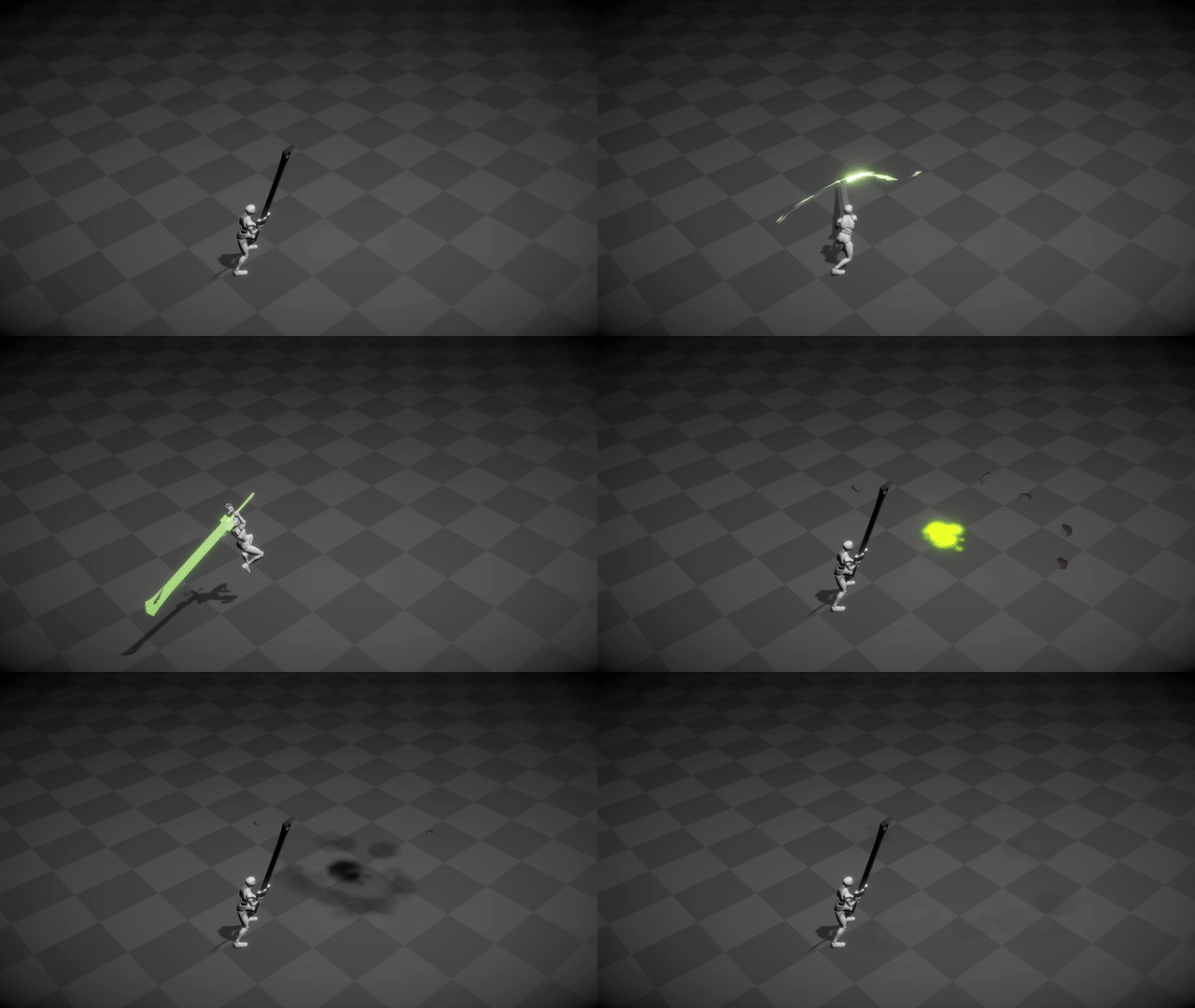
Lightning Melee Combo
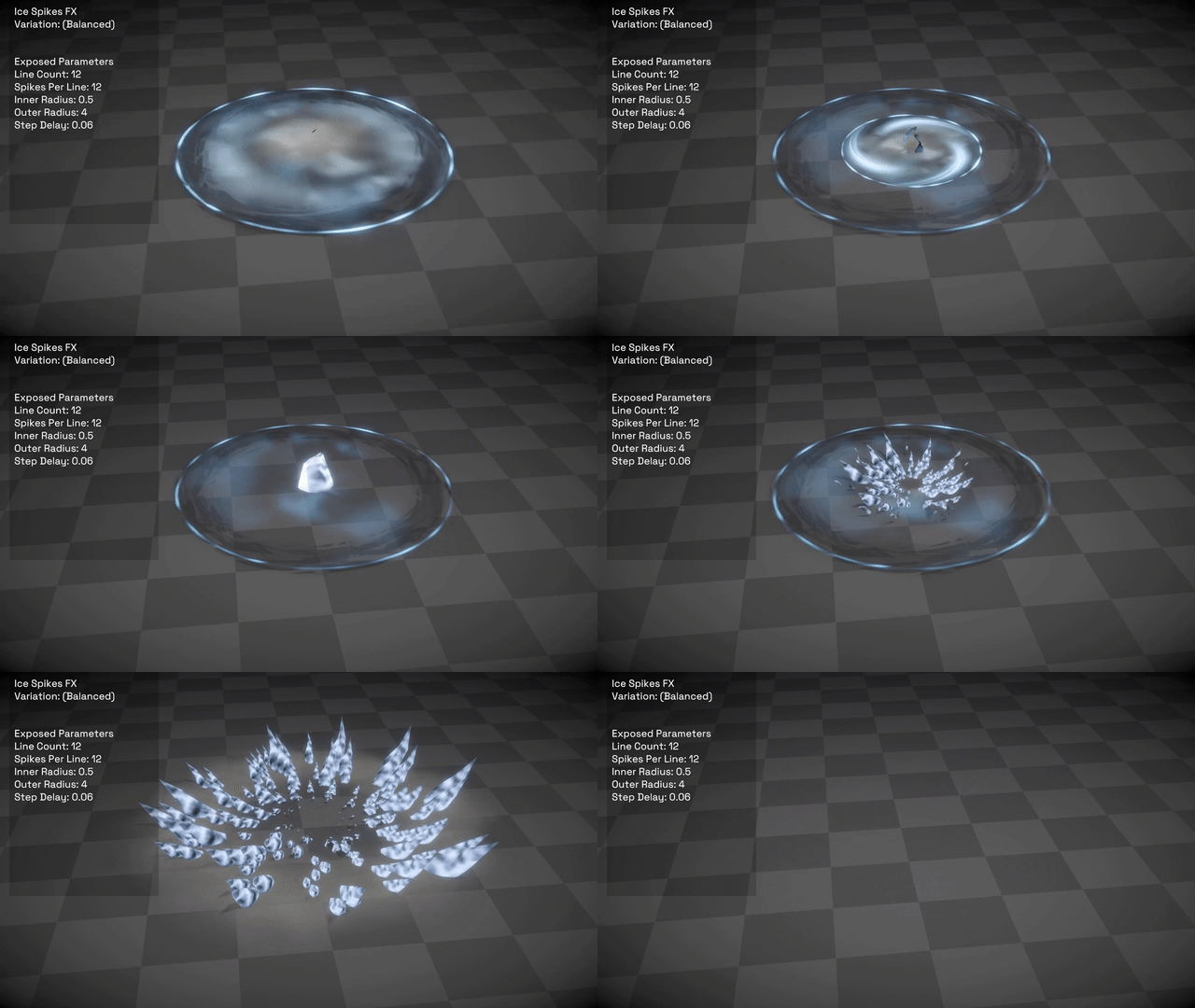
Modular Ice Spikes
Team Project: ASGC Studio Jam
A stylized steampunk action-adventure game built by a multidisciplinary team in ASGC’s studio-simulation game jam. VFX specialist on the tech art team, working in Unreal Engine 5. Jul 2026 – Jan 2027.
Unreal Engine 5 • Niagara • Material Functions • Blueprints • Team Pipeline
Highlights
• “Bleaching” disease effect using material overlays and material functions, with the spread triggered on collision via Blueprints• Modular Niagara gas emitters (steam, smoke, dust) delivered to the master build for level prototyping• Git feature-branch workflow with lead-approved merges into the master build• Taking on art-asset integration for the programming and level design teams
Research Internship: Nano Arsenal
A Unity FPS + AR prototype where players describe weapon changes in plain language and an AI-generated recipe reconfigures hand-authored VFX and gameplay modules. Solo research project, TEEP at Da-Yeh University, Taiwan. Jun – Sep 2026.
Unity VFX • Modular Effects • Shader Graph • AR (ARCore) • AI-Driven Recipes
Highlights
• 12 hand-authored VFX modules: 3 shape families (Bullet, Beam, Explosion) × 4 roles (Muzzle, Core, Trail, Impact)• Runtime-tunable palettes, emission, particle size, lifetime and role scale, limited to approved parameters• Rebuilt the library from elemental themes into shape families, so a small set of effects could combine into many weapon looks• Runs on PC and Android, with an AR Workbench for inspecting effects from any angle
Game Jam: Mind The Gap!
A 3D bullet hell survival game built for Bullet Hell Jam 7, where players fight across unstable mushroom platforms, collect crystals, choose upgrades, and survive escalating enemy waves and dragon boss encounters. Made in 10 days
Unity VFX • Combat Readability • Boss Attacks • Upgrade-Driven Effects • Game Jam
Key Systems
• Combat VFX built with Particle Systems, Line Renderers and URP materials• Chain lightning and a dragon fire-breath boss attack, timed to gameplay through animation events• Effects that scale with upgrades: multi-projectile, chaining, echo and pierce• Data-driven attack and upgrade system (ScriptableObjects) shared by the player, enemies and boss
Silvern Moonrise
A 2D pixel-art roguelite with timeline-based combat, where players read enemy intent and sequence abilities to counter it. Steam page live; release targeted 2027.
Pixel-Art VFX • Combat Readability • Telegraphs • Timeline Combat • Unity
Key Systems
• Pixel-art attack effects built with Shuriken particle systems• Combat feedback: action previews and enemy intent telegraphs, so threats read at a glance• A timeline that queues, previews and resolves actions• Modular abilities and status effects
Secrets of Shadows
A 2D pixel-art tactics RPG roguelike, made in collaboration with a composer. 2,000+ Steam wishlists.
Pixel Art • Original 2D Art • Tactics • Grid Combat • Steam
Key Systems
• Original 2D art, animated sprites and tilemap levels• Grid movement and turn-based tactical combat• Enemy AI with A* pathfinding, tuned so its behaviour stays readable• Encounter design that rewards positioning
Game Jam:"FUSINO" Fusion ON!
A rhythm-based game developed in 7 days for the Brackeys Game Jam, focused on timing-driven gameplay and responsive input systems.
Rhythm Systems • Input Timing • Game Jam • UI • Audio Integration • Rapid Prototyping
Key Systems
• Developed a complete playable rhythm game within a 7-day game jam• Ranked #6 in Audio and #10 in Enjoyment out of 2100+ entries• Built timing-based input systems synchronized with music tracks• Collaborated on integrating gameplay with custom-composed audio
Team Project: ASGC Studio Jam
VFX Artist, Tech Art Team · Unreal Engine 5 · Jul 2026 – Jan 2027
Key Systems
• Bleaching disease effect: a material overlay applied to props on collision. Material functions drive the bleached look, and the spread is triggered through Blueprints.• Designer controls: the spread radius (Max Radius) is exposed on the Blueprint, so each prop can be tuned without editing the material.• Modular gas emitters: a set of Niagara emitters for steam, smoke and dust, including ring-shaped steam variants, delivered to the master build for level prototyping.• Team pipeline: work is delivered through Git feature branches and merged into the master build after lead approval.
Implementation Highlights
• Built the bleaching effect as a reusable Blueprint prop, with a collision trigger and an exposed radius, that can be placed on any mesh.• Kept the bleached look in material functions, so the same treatment can be reused across materials.• Built the gas emitters as modular pieces that level designers can drop into greybox scenes.• Took on art-asset integration, bringing team members’ models and assets into the build for the programming and level design teams.
Challenges / Decisions
• Making emitters general enough to be useful while the levels were still being greyboxed and the final art direction was still changing.• Making the bleaching spread read clearly in a stylized toon look, without overwhelming the props it lands on.• Working safely in a shared master build alongside programmers and level designers, using branches and lead reviews.
Notes
ASGC is a studio-simulation game jam running through January 2027, structured like a real production team. The bleaching effect was well received in team WIP reviews and is being prepared for the build; the gas emitters are already in the master build for prototyping.
Research Internship: Nano Arsenal
A 3D bullet hell survival game built around movement, upgrades, and readable combat VFX. Players fight across mushroom platforms, collect crystals, purchase upgrades between waves, and survive enemy swarms leading into dragon boss encounters.
Solo research project · TEEP, Da-Yeh University, Taiwan · Unity 6 · Jun – Sep 2026

Default Beam Family

Default Bullet Family
Default Cannon Family

Runtime 'Shotgun' applied to Beam family
Runtime 'Shotgun' applied to Bullet family
Runtime 'Shotgun' applied to Cannon family


Key Systems
• Modular VFX library: 12 hand-authored modules, made from 3 shape families (Bullet, Beam, Explosion) across 4 roles (Muzzle, Core, Trail, Impact).• Tunable visuals: primary, secondary and accent colour palettes, plus emission, particle size, lifetime and role scale, all limited to approved parameters.• Separating shape from element: the Cryo, Electric and Plasma status effects stay in gameplay data, while the chosen shape family supplies the look.• Recipe pipeline: a player prompt plus the current weapon goes in, and a structured recipe comes out. Unity validates it before applying it to the modules.
Implementation Highlights
• Rebuilt the original elemental library (Plasma, Cryo, Electricity) into shape families, so a small set of effects could combine into many more weapon looks.• Bullet is a compact silhouette.
Beam is an elongated energy shape with optional outward electricity. Explosion is a shell-and-gas burst where the shell and gas can be switched on and off separately.• Runtime tuning changes the spawned instances and material properties, never the source prefabs.• Gameplay settings add variety: a wide multi-projectile spread makes the same family read very differently from a narrow single shot.• Built with Unity 6, URP, Particle Systems, Shader Graph and AR Foundation/ARCore, with a FastAPI and OpenAI server that checks every recipe.
Challenges / Decisions
• Protecting the base silhouette: Bullet keeps its original geometry so recipes can’t push it to oversized results, while Beam and Explosion stay adjustable.• Keeping visuals and hit detection separate: the size of an effect never determines its collision. The projectile’s checked collision shape is what counts.• The library limits what AI can produce: text requests can ask for more than the modules can show, and a valid recipe doesn’t guarantee a good-looking result.• Fast iteration: separate PC and AR workbenches made it possible to tune effects without replaying the combat loop each time.
Notes
All VFX modules and their tuning were hand-authored. AI tools assisted software development and power the runtime recipe generation. Third-party models, animations and sounds provided supporting content and are credited in the project report. Delivered with a final presentation to the TEEP program.
Mind The Gap!
A 3D bullet hell survival game built around movement, upgrades, and readable combat VFX. Players fight across mushroom platforms, collect crystals, purchase upgrades between waves, and survive enemy swarms leading into dragon boss encounters.
Unity VFX • Bullet Hell • Wave Survival • Boss AI • Upgrades • WebGL

Dragon Boss Showcase
ScriptableObject Upgrade System
Playable Character - Vagabond
Playable Character - Dragon Knight


Key Systems
• Data-driven attack system supporting ranged, melee, magic, chaining, echo, knockback, and projectile blocking• Upgrade shop built around ScriptableObject upgrade data, tier requirements, costs, rarity metadata, and reusable UI panels• Wave manager with timed waves, enemy spawn caps, mushroom-based spawn points, final-wave defeat conditions, and cleanup logic• Enemy AI supporting movement, attacking, platform jumping, contact damage, knockback response, and spawn climb behavior• Dragon boss AI using animation events to sync landing impacts, fire attack windows, and movement phases
Implementation Highlights
• Built reusable AttackDataSO and UpgradeData systems so player weapons, enemies, and bosses could share the same attack logic• Created a wave spawning system that supports multiple enemy archetypes, per-wave spawn rules, spawn caps, dragon-specific spawn locations, and final-wave victory logic• Implemented a shop flow with rerolls, purchase states, animated upgrade cards, crystal tracking, and additive upgrade stacking• Added integrated combat VFX for melee sweeps, magic links, projectile impacts, dragon attacks, hit feedback, and UI transitions• Shipped a WebGL build on itch.io with custom fullscreen scaling, menu flow, character selection, victory/game-over states, and retry options
Challenges / Decisions
• Keeping combat readable while many enemies, projectiles, pickups, and VFX were active at once• Separating the jam build from later portfolio polish so the submitted version remained stable• Synchronizing dragon animation timing with gameplay events such as landing attacks and fire windows• Avoiding overcomplicated pathfinding by using simpler platform jump and spawn rules suitable for a jam-scale project
Notes
This project was built as a game jam entry over 10 days and now serves as a Unity gameplay/VFX portfolio piece. The focus was on creating a complete playable loop with data-driven combat systems, upgrade progression, enemy variety, boss behavior, WebGL deployment, and integrated real-time VFX.
Silvern Moonrise
A 2D roguelite built around a timeline-based combat system, where players read enemy intent and sequence abilities to counter actions
Gameplay Systems • Combat Design • AI • UI • Modular Architecture
![Combat Timeline Showcase]()
Combat Timeline Showcase
![Randomized Upgrade System]()
Randomized Upgrade System
![Positional Combat Showcase]()
Positional Combat Showcase
![Status Effect Showcase]()
Status Effect Showcase
![Modular Skill Tree]()
Modular Skill Tree


Key Systems
• Timeline system for queuing, previewing, and resolving actions• Modular ability system supporting composable effects• Enemy AI with intent telegraphing• Combat UI for turn order and action feedback
Implementation Highlights
• Built a dynamic timeline that recalculates action order as abilities are added or changed• Used ScriptableObjects for data-driven, reusable ability definitions• Implemented enemy actions as timeline-driven entries with visible pre-execution intent• Connected UI to gameplay using event-driven updates for responsive feedback
Challenges / Decisions
• Keeping the timeline readable as multiple actions stack and update dynamically• Balancing flexible ScriptableObject abilities with predictable outcomes• Making enemy intent clear without reducing decision-making depth• Avoiding over-engineering while keeping systems modular
Notes
This project serves as my primary systems-focused portfolio piece, with ongoing work on improving visual feedback and integrating gameplay VFX.
Secrets of Shadows
A 2D tactics roguelike centered on grid-based combat and AI-driven encounters. The project focuses on pathfinding, enemy behavior, and designing combat spaces that emphasize positioning and movement.
AI • Pathfinding • Tactics • Grid Systems • Tilemap • Level Design
![Ability Showcase]()
Ability Showcase
![UI Showcase]()
UI Showcase
![Passive Tree Showcase]()
Passive Tree Showcase
![Loadout Screenshot]()
Loadout Screenshot


Key Systems
• Grid-based movement and turn-based combat system• Enemy AI with pathfinding-driven navigation and decision-making• Tilemap-based level design supporting tactical encounters• Combat interactions focused on positioning and movement
Implementation Highlights
• Implemented A* pathfinding for enemy navigation across grid-based environments• Built enemy AI using state-driven logic for movement, targeting, and actions• Structured grid and tilemap systems to support movement, collision, and traversal• Designed encounter spaces using Unity Tilemap tools to control flow and positioning
Challenges / Decisions
• Balancing pathfinding accuracy with predictable and readable enemy behavior• Preventing AI from feeling overly optimal or frustrating in tight spaces• Designing grid layouts that encourage meaningful positioning decisions• Keeping combat readable while managing multiple moving entities on a grid
Game Jam Entry: "FUSINO" Fusion ON!
A rhythm-based game built in 7 days for the Brackeys Game Jam, focused on timing-based input and music-synced gameplay.
Ranked #6 in Audio and #10 in Enjoyment out of 2100+ entries.
Rhythm Systems • Input Timing • Game Jam • UI • Audio Integration • Rapid Prototyping
![Track 1 Showcase]()
Track 1 Showcase
![Track 2 Showcase]()
Track 2 Showcase
![Track 3 Showcase]()
Track 3 Showcase
![Game Jam Cover Art]()
Game Jam Cover Art


Key Systems
• Timing-based input system synchronized with music• Multi-track rhythm gameplay with scoring and feedback• UI systems for timing windows, feedback, and player input• Audio-driven gameplay flow tied to track progression
Implementation Highlights
• Integrated music timing using MIDI-based data for accurate input windows• Built input handling systems to evaluate timing accuracy against audio playback• Implemented scoring and feedback systems based on hit timing precision• Structured gameplay to stay synchronized with audio across multiple tracks
Challenges / Decisions
• Maintaining accurate input timing while accounting for audio latency• Synchronizing gameplay systems tightly with music playback• Balancing difficulty to keep gameplay responsive but not overly punishing• Delivering a complete and polished experience within a 7-day time constraint